How to Run Meetings People Actually Want to Attend

A meeting can make a group feel focused, useful, and ready to act. It can also drain the life out of a room in under ten minutes.
Student councils, club boards, youth councils, honor societies, service groups, and nonprofit committees often have the same problem: good people show up, but the meeting goes in circles. Someone talks too long. No one knows what needs to be decided. The group spends half the time reviewing things that could have been sent in a message. Then everyone leaves with vague plans and no clear next step.
A good meeting does not happen by accident. It needs a clear purpose, a simple agenda, active participation, and follow-up that turns talk into action. The goal is not to run the most formal meeting possible. The goal is to run a meeting people can trust with their time.

Know why student meetings become boring or unproductive
Most bad meetings are not bad because people do not care. They are bad because the meeting has no clear job.
A meeting gets boring when it becomes a place for updates that could have been shared in writing. It gets unproductive when the group talks about every issue but decides nothing. It gets frustrating when a few voices take over and everyone else becomes an audience.
Common meeting problems include:
No clear purpose
People arrive without knowing whether they are brainstorming, deciding, planning, or reporting.
Too many agenda items
The group tries to cover ten things and does none of them well.
No time limits
One topic expands until it eats the whole meeting.
Unclear roles
No one knows who is leading, taking notes, watching the time, or following up.
Vague endings
Everyone leaves with good intentions, but no names, deadlines, or action items.
The fix is not to make meetings stricter for the sake of being strict. The fix is to make them easier to follow. People participate more when they understand the purpose, the plan, and how their input will be used.
Set a clear purpose before you build the agenda
Before you invite people or open the meeting, answer one question:
What should be different by the time this meeting ends?
That question forces the meeting to have a result. If the answer is “everyone should know the volunteer schedule,” you may not need a meeting. A message, shared document, or group chat post might work better.
If the answer is “we need to choose the fundraiser idea and assign teams,” then a meeting makes sense.
Good meeting purposes sound like this:
Decide which service project to run next month
Assign roles for the school event
Review what worked at the last fundraiser and choose two changes
Plan the next three steps for a donation drive
Vote on a budget request
Collect member ideas for a new club tradition
Weak purposes sound like this:
Talk about the event
Go over stuff
Check in
Discuss fundraising
Plan things
Those phrases are too broad. They do not tell people what kind of thinking to bring.
Once the purpose is clear, share it before the meeting. A simple one-sentence purpose at the top of the agenda can change the whole tone.
For example:
Purpose of this meeting
Choose one spring service project, assign planning roles, and confirm the first deadline.
Now people know what success looks like.
Create an agenda that protects everyone’s time
An agenda is not just a list of topics. It is a plan for how the meeting will use people’s attention.
A good agenda tells the group:
What will be covered
How long each item should take
Whether the group needs to discuss, decide, brainstorm, or simply listen
Who is leading each item
What outcome is expected
Here is a simple agenda format that works well for student groups and service organizations:
Time | Item | Goal | Leader |
0:00 to 0:03 | Welcome and purpose | Set the focus | President or chair |
0:03 to 0:08 | Quick updates | Share only what affects the group | Officers |
0:08 to 0:18 | Main discussion | Compare options | Project lead |
0:18 to 0:23 | Decision | Choose one plan | Chair |
0:23 to 0:28 | Action items | Assign names and deadlines | Secretary |
0:28 to 0:30 | Wrap-up | Repeat next steps | Chair |
The agenda should not be packed edge to edge. Leave a little room for questions, late-breaking issues, or a quick clarification. If every minute is overloaded, the meeting will fall behind right away.
Before the meeting, ask officers or committee leads what needs to be included. Then sort each item into one of four types:
Update
Share information quickly. No long discussion unless needed.
Discussion
Gather opinions, questions, or ideas.
Decision
Choose a direction, approve a plan, or vote.
Action
Assign work to specific people.
This small step prevents confusion. If the group thinks it is making a decision but the leader only wanted feedback, people may feel ignored. If the leader expects a decision but the group keeps brainstorming, time disappears.
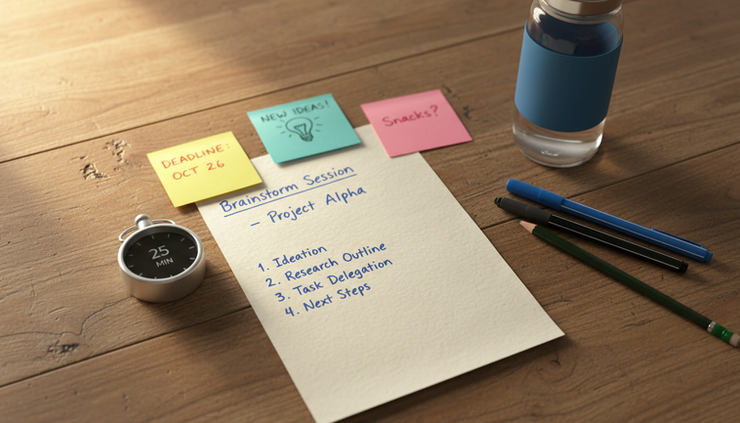
If your group meets often, use a repeatable template. A free meeting-agenda template on the website can save time and help every leader follow the same basic structure.
Start and end on time so people trust the meeting
Time is one of the easiest ways to show respect.
Starting late teaches people that being on time does not matter. Ending late teaches people that the meeting may interfere with homework, practice, work, rides, family plans, or other commitments.
Start when you said you would start, even if a few people are missing. You can welcome late arrivals quietly, but do not restart the meeting for them. After a few meetings, people will adjust.
A strong opening can be short:
“Thanks for being here. We have 30 minutes. By the end, we need to choose our service project and assign the first planning tasks. Here is the agenda.”
That opening does three things. It thanks people, names the time limit, and reminds everyone of the goal.
To end on time, use three habits:
Put time estimates on the agenda
If a topic gets five minutes, say so.
Use a timekeeper
This can be someone other than the chair. Their job is to give quiet reminders, such as “two minutes left.”
Move unfinished topics to a parking lot
A parking lot is a short list of good topics that are not for this meeting. Write them down so people feel heard, then return to the agenda.
Ending well matters as much as starting well. Do not let the meeting fade out with side conversations and half-decisions. Use the last two minutes to recap:
What the group decided
Who is doing what
When each task is due
When the group will check in again
People should leave knowing exactly what happens next.
Keep people involved without letting one person take over
A meeting people actually want to attend gives people a real way to contribute. That does not mean everyone must talk for the same amount of time. It means the meeting should not belong to only the loudest voices.
Some members think out loud. Some need a moment before they speak. Some have great ideas but do not want to interrupt. A good leader makes room for different participation styles.
Try these methods:
Start with a quick round
Ask each person to share one idea, concern, or update in 30 seconds or less.
Use silent thinking time
Give everyone one minute to write ideas before discussion starts. This improves the quality of responses and helps quieter members join in.
Pair people first
Let members talk with one partner before sharing with the full group.
Ask specific questions
“What is one problem we need to solve before Friday?” works better than “Thoughts?”
Invite missing voices
Say, “We have heard a few ideas. I want to make space for anyone who has not spoken yet.”
Dominating conversations can be tricky, especially when the person means well. The goal is to redirect without embarrassing them.
Use calm, clear phrases:
“I’m going to pause you there so we can hear from a few others.”
“That is helpful. Let’s get two more voices before we decide.”
“I want to keep us on time, so let’s bring this back to the question.”
“Can you summarize your main point in one sentence?”
If someone regularly takes over, talk privately after the meeting. Be kind but direct.
“You bring a lot of energy and ideas, which helps the group. I also need to make sure others have space to speak. At the next meeting, can you help me by jumping in after a few other people have shared?”
That turns the person into part of the solution.

Make decisions and assign responsibilities before people leave
Meetings often feel productive while people are talking. The real test comes at the end. Did the group decide anything? Did anyone agree to do the work? Does everyone know the next step?
When a decision is needed, name the method before the discussion starts. Do not let the group guess.
Common decision methods include:
Method | Works best when |
Consensus | The group needs broad agreement and the issue affects everyone |
Vote | The options are clear and the group can accept the majority choice |
Leader decision | Time is short or the leader is responsible for the result |
Committee recommendation | A smaller team has researched the issue and presents a plan |
For student organizations, voting can work well when the choices are simple. Consensus can work well when buy-in matters, such as choosing a service project that needs many volunteers.
Before deciding, make sure the options are clear. Instead of “What should we do for the fundraiser?” narrow it down:
“We have three options: a bake sale, a car wash, or a restaurant night. We need to choose one today based on cost, time, and number of volunteers.”
Once the decision is made, move right into responsibilities. This is where many meetings fall apart. People say “we should make flyers” or “someone should contact the shelter.” That sounds useful, but it assigns nothing.
Use action items with three parts:
Task
What needs to be done
Owner
One person responsible for making sure it happens
Deadline
When it needs to be finished
For example:
Task | Owner | Due date |
Ask the advisor to approve the event date | Maya | Friday |
Create a volunteer sign-up form | Jordan | Sunday evening |
Contact the food pantry about needed items | Luis | Tuesday |
Draft morning announcement script | Priya | Monday |
One task can have helpers, but it should have one owner. If everyone owns it, no one really owns it.
The note-taker should record decisions and action items during the meeting, not afterward from memory. These notes do not need to be fancy. They need to be accurate.
Meeting notes should include:
Date and group name
People present
Main decisions
Action items with owners and deadlines
Items saved for later
Next meeting date, if known
Send the notes soon after the meeting, ideally the same day. A short follow-up keeps the energy from disappearing.
A follow-up message can be simple:
“Thanks for coming today. We chose the food pantry drive for April. Action items are below. Please reply by tomorrow if anything is missing or incorrect.”
Then list the tasks.

Use a simple 30-minute meeting structure
A 30-minute meeting is long enough to make progress, but short enough to keep energy high. The key is to limit the number of goals. A short meeting cannot handle every issue your group faces.
Here is a sample structure you can adapt.
Time | What happens | Why it matters |
0:00 to 0:02 | Welcome, purpose, and agenda | Focuses the room right away |
0:02 to 0:06 | Quick updates | Shares only the information people need |
0:06 to 0:16 | Main topic discussion | Gives the group time to compare ideas |
0:16 to 0:21 | Decision or next step | Turns discussion into direction |
0:21 to 0:27 | Assign responsibilities | Makes sure the work has owners |
0:27 to 0:29 | Review action items | Catches confusion before people leave |
0:29 to 0:30 | Closing and next check-in | Ends clearly and on time |
If your meeting needs more discussion, reduce updates. If it needs planning, send background information ahead of time. If it needs creativity, use silent brainstorming before open conversation.
The best agenda is not the longest one. It is the one that helps the group leave with clarity.
Follow up so the meeting keeps mattering
The meeting is only half the job. Follow-up is what makes the meeting worth attending next time.
Send a short recap that includes the decisions and action items. Remind people of deadlines before they pass. If someone misses a task, check in early instead of waiting until the next meeting to discover the problem.
A good follow-up message should be:
Short enough that people will read it
Clear enough that no one has to ask what they agreed to do
Sent soon enough that the meeting is still fresh
Stored somewhere the group can find it later
For ongoing groups, keep one shared folder or document for agendas and notes. New officers, committee chairs, and members can look back and understand what happened without starting from scratch.
Strong meetings create a loop:
Set a purpose.
Build an agenda.
Start on time.
Involve people.
Decide clearly.
Assign action items.
Follow up.
Use what you learned to make the next meeting better.
That loop builds trust. People attend because the meeting helps them do meaningful work, not because they feel obligated to sit through it.
If your group wants an easy starting point, use the free meeting-agenda template on the website and customize it for your next student council, club, youth council, NHS, or service organization meeting.
A meeting people want to attend is not perfect. It is prepared, respectful, and clear. When people know why they are there, how they can contribute, and what happens next, the meeting stops feeling like a time filler and starts feeling like progress.


Comments